If California’s capital punishment law is found to violate the state constitution, it may provide a template for death penalty opponents in other states.
Read more She’s a Trump acolyte. He’s a ‘gringo Sandinista.’ Meet the Harps.
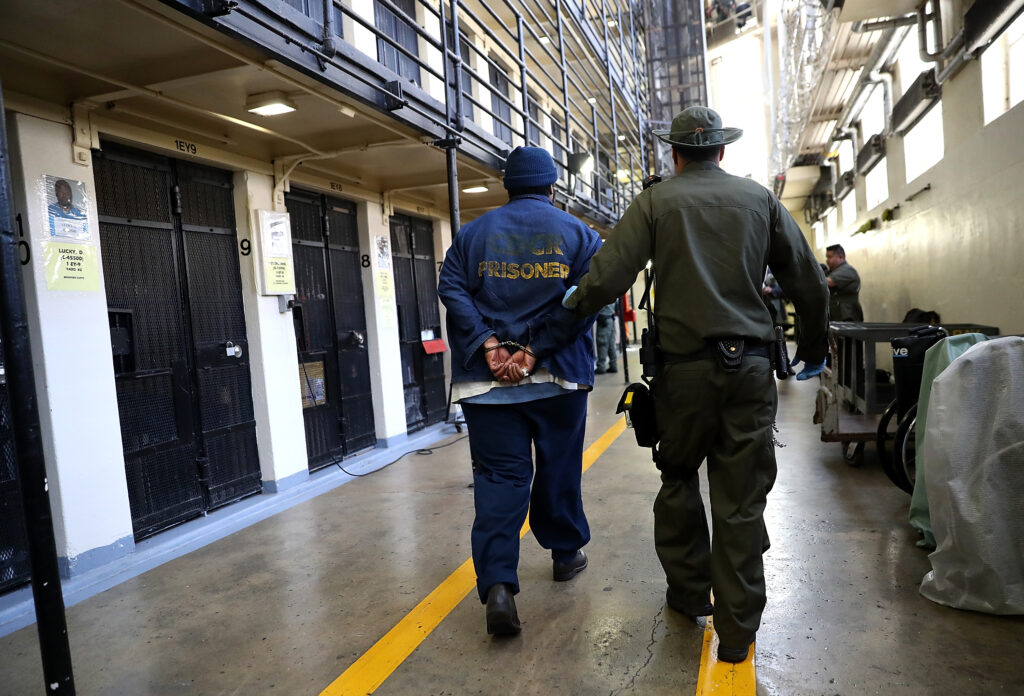
California’s defense attorneys for years saw their Black and Latino clients sent to death row at a rate much higher than other defendants accused of the same crimes.
The data showed that Black people were up to 8.7 times — and Latinos up to 6.2 times — more likely to be sentenced to death than others convicted of similar murder charges, according to academic studies. And those of all races were up to 8.8 times more likely to be condemned when at least one of the victims was White.
So a coalition of civil rights groups in California decided to get creative, launching a novel lawsuit in state court saying the death penalty’s racial tilt violated the state constitution — despite a landmark U.S. Supreme Court decision finding that disparity data alone did not mean capital punishment violated the federal Constitution.
It’s the first time a state’s death penalty statute has been challenged on systemic grounds untethered to an individual case, potentially paving a new legal pathway for capital punishment opponents in other states. If several more states abolish the death penalty, it would represent a significant shift in the national landscape, experts suggest.
“It would be meaningful in demonstrating where things are heading in this country, meaningful in isolating the states that continue to pursue and utilize the death penalty,” said Carol Steiker, a Harvard law professor and leading capital punishment expert.
For now, the U.S. Supreme Court has a solid conservative majority and is unlikely to revisit the federal constitutionality of the death penalty. But if enough states abolish it, Steiker said, a different version of the high court might be persuaded to take another look.
“A future court might very well look at a landscape that continues to move in this direction,” she said, “and find a global constitutional action possible.”
The lawsuit, an extraordinary request called a petition for writ of mandate, has cleared an initial hurdle at the California Supreme Court and will now be litigated in a Sacramento. A lower-court judge there is scrutinizing whether racial disparity data in 15 empirical studies proves petitioners’ claim that, as written, California’s death penalty statute violates the equal protection and cruel and unusual punishment clauses of the state constitution.
“We are not saying the death penalty is inherently racist,” said Lisa Romo, who spearheaded the lawsuit’s research for the Office of the State Public Defender. “We are saying the way our death penalty is currently being applied has unacceptable racial disparities.”
The legal journey will likely be long. California is an overwhelmingly Democratic state, but it has the most people on death row with nearly 600 inmates awaiting execution. Gov. Gavin Newsom (D) has suspended executions for now.
California law lists 22 factors making a homicide defendant eligible for the death penalty — for example, if gang activity was involved or the victim was a police officer. That is the most special circumstances of any state and, petitioners argue, a key cause of the racial disparities.
“Every day that this system is in place in this way, yielding these results, is another day that folks in California are subject to racial prejudice that is legitimized by this system,” said Joseph Wong, senior counsel at the Legal Defense Fund, one of the groups that filed the suit. “That is part of the reason for our urgency.”
Court filings from the office of California Attorney General Rob Bonta, a Democrat, say the state is taking the racial disparity claims seriously. Bonta’s office is now examining the methodology of the studies, the filings say, a process that will require expert opinions.
“Racial discrimination in the administration of a criminal justice system is unacceptable,” Bonta’s office wrote in court papers filed last week. “And in the Attorney General’s view, the statistical findings in the studies invoked by petitioners are extraordinarily disturbing.”

District attorneys in the California counties that most prolifically seek the death penalty have stepped in, filing briefs saying they vehemently disagree with the petition arguments, the attorney general’s mixed response and the idea that this lawsuit should proceed at all.
“Petitioners ask this Court to help them reach a goal that they could not achieve at the ballot box: abolition of capital punishment across California,” the Riverside County DA’s office wrote. It added that the lawsuit was not so much a legal claim as a “political campaign filed before the wrong branch of government.”
The challenge to California’s death penalty comes at a fraught moment for capital punishment in the United States. While Americans’ approval of the death penalty continues to decline, President Donald Trump has made capital punishment a core tenet of his tough-on-crime messaging. He ended a Biden-era moratorium on federal executions and has ordered the Justice Department to prioritize capital punishment.
Yet nearly half of U.S. states have abolished capital punishment, according to the Death Penalty Information Center, and only about a dozen are actively carrying out executions. Last year, 40 percent of the nation’s executions took place in Florida, where Republican Gov. Ron DeSantis has broken several state records related to the death penalty.
Sitting governors in four states have paused executions for the duration of their terms. Newsom announced in 2019 that he was closing the state’s death chamber, repealing the lethal injection protocol and placing an indefinite moratorium on executions.
“Our death penalty system has been, by all measures, a failure,” Newsom said at the time. “It has discriminated against defendants who are mentally ill, Black and Brown, or can’t afford expensive legal representation.”
Bonta has made similar declarations, saying in 2021 that studies show the state’s death penalty has “long had a disparate impact on defendants of color, especially when the victim is White.”
The words of both officials are cited in the lawsuit.
“This petition for the first time presents this Court with an opportunity to directly address the widely recognized data establishing that California’s death penalty provisions are administered in a discriminatory manner,” it says.
The stakes are high because if the state’s death penalty law is struck down, a new statute is unlikely in overwhelmingly Democratic California, political analysts say — making this a de facto fight over the existence of the death penalty in the nation’s largest state.
Read more Led by Olivia Miles, Lynx end Mystics’ home winning streak
The California Supreme Court has already abolished the death penalty once, ruling in 1972 that it violated the state constitution’s ban on cruel and unusual punishment. But voters quickly brought it back, overwhelmingly approving a ballot initiative to amend the state constitution and reverse the court’s decision.
Since then, just 13 people have been executed in California, the result of a U.S. Supreme Court case that temporarily paused executions nationwide and other related litigation.
Capital punishment opponents in California tried to end it again in 2016, but voters narrowly rejected a statewide ballot initiative to repeal the death penalty and replace it with a sentence of life in prison without parole.
But in 2020, as George Floyd’s murder focused attention on racism in the criminal justice system, Newsom signed the Racial Justice Act, seeking to lower the legal hurdles for defendants trying to prove that racism had seeped into their court proceedings. That included everything from racist language at trial to racial animus by court officials to racial disparities in prosecution and sentencing.
If a judge finds a violation of the Racial Justice Act, a case can be tossed, recharged, retried or resentenced. Most critically, it can take the death penalty off the table for that defendant.
Many of the civil rights organizations that advocated for the Racial Justice Act are now petitioning the court to deem the death penalty unconstitutional: the American Civil Liberties Union, Witness to Innocence, the Ella Baker Center for Human Rights, and the Equal Justice Society.
They acknowledge the power of the Racial Justice Act but say it is limited. Individual death penalty challenges are time consuming, labor intensive and expensive, creating enormous hurdles for defendants or inmates who cannot afford private attorneys, which is most people on death row.
“There was always going to be an argument in our case: Why is systemic relief necessary when the Racial Justice Act allows for individuals to claim that racism negatively impacted their conviction or sentence?” said Avi Frey, deputy director of the criminal justice program at the ACLU of Northern California. “The counter argument … is: Who’s going to bring all these cases?”
Of the nearly 600 people currently on death row, Frey said, only about 100 have attorneys. In addition, post-conviction claims can take decades to resolve.
So the legal team behind the petition — including the WilmerHale law firm, the Legal Defense Fund, the ACLU and the California public defender — went straight to the top, seeking a writ of mandate directly from the state’s high court.
“It’s a statewide challenge,” Wong said. “It made sense for it to be brought in a statewide fashion.”
Soon after the initial petition was filed in 2024, the Riverside County District Attorney’s Office decided to enter the legal fight.
Of the 565 people currently on California’s death row, Riverside is responsible for 87, or about 15 percent, second only to Los Angeles County.
California is a highly polarized state, with the southern portion far more conservative than the north. Officials of Riverside County, a slice of the state at its southern end, have historically viewed capital punishment as a critical tool for pursuing justice.
The death penalty opponents’ lawsuit was filed against the California attorney general. But Riverside’s prosecutors worry that Bonta, who advocated for the abolishment of the death penalty as a state lawmaker, will not adequately represent their interests, or those of murder victims’ families.
Emily R. Hanks, manager of the appellate unit at the Riverside District Attorney’s Office, said it’s California’s 58 district attorneys, not the state attorney general, who prosecute capital punishment cases. The challengers’ tactic of seeking a statewide court order instead of making racism claims in individual cases is completely inappropriate, she added.
“There is a proper way to do this. There’s a proper way to challenge it,” Hanks said. “This is not proper.”
Riverside County also called the data from the racial disparity studies “outdated, irrelevant and inaccurate” in its court filings. The DA’s office in San Bernardino County, just north of Riverside, made a similar argument.
The case is an unorthodox one, as have been the proceedings so far.
It was originally filed before the state Supreme Court, but it will not be litigated there, at least not initially. The state’s high court asked for briefings from relevant parties, then kicked the case down to the Sacramento Superior Court and ordered a judge there to conduct evidentiary hearings.
If the petitioners succeed, it would not be the first time a state has unilaterally ended its death penalty on racial grounds. States including Connecticut and Washington struck down their capital punishment laws after legal challenges presented evidence of racial disparities.
But if the California challengers prevail, Steiker said it could pave the way for death penalty opponents in additional states like Kansas, Pennsylvania and Oregon to attempt similar challenges.
Given the current makeup of the U.S. Supreme Court, that might be their best bet, some death penalty opponents say.
“You don’t need federal permission to litigate what state constitutions mean,” Steiker said. “The federal constitution is the floor, and the states can go beyond it. And that’s what this litigation is all about.”
Read more Ed Martin leaving Justice Dept. after tumultuous tenure that alienated colleagues