In today’s edition … Data centers are bringing out a unique divide on the right … The Supreme Court ends its term with a bang … We ask for your help … but first …
Read more Voters are angry with Washington, and other takeaways from the Colorado primaries
It remains difficult to leave a deeply unpopular Congress.
Democratic voters selected Attorney General Phil Weiser over Sen. Michael Bennet in Colorado’s Democratic primary for governor on Tuesday. Bennet’s loss in a race that largely focused on who would more forcefully confront President Donald Trump is also a repudiation of the Democratic establishment in a Congress with a near record-low approval rating.
State Rep. Manny Rutinel will also represent Democrats in the state’s key congressional race north of Denver, offering voters a more progressive option by defeating former state representative Shannon Bird. Rutinel will face Rep. Gabe Evans in November.
Plus, lawyer and democratic socialist Melat Kiros, 29, ousted Rep. Diana DeGette, a liberal, 30-year incumbent from Denver in a Colorado House primary.
There is an interesting divide over data centers playing out on the right.
On one side is political opinion. With a string of polls showing the vast majority of Americans — and even a majority of Republicans — oppose data center construction in their communities, some conservative candidates have positioned themselves as a bulwark to the data centers that power artificial intelligence.
Rep. Byron Donalds, the Trump-backed candidate in Florida’s Republican gubernatorial primary, has been running ads in the race pledging to “protect Florida families and communities from data centers that jack up utility rates and make everything else more expensive.”
“You don’t want to pay for AI data centers, and when I’m governor, you won’t,” Donalds says in the spot.
Donalds is not alone. A handful of Republicans from Texas to Pennsylvania to Michigan have warned about data center construction — with some calling for a temporary pause on building new ones.
On the other side? Support for the AI industry and concerns about losing the AI war to China. This view, along with the substantial money the tech industry has shown it is willing to spend on elections, has led some Republican candidates to stake out firmly pro-AI positions, despite the public polling.
This tension among Republicans underscores the complicated politics and unique coalitions around artificial intelligence — something our colleagues Liz Goodwin and Riley Beggin have documented — and will be a story to watch on the right ahead of November’s midterms.
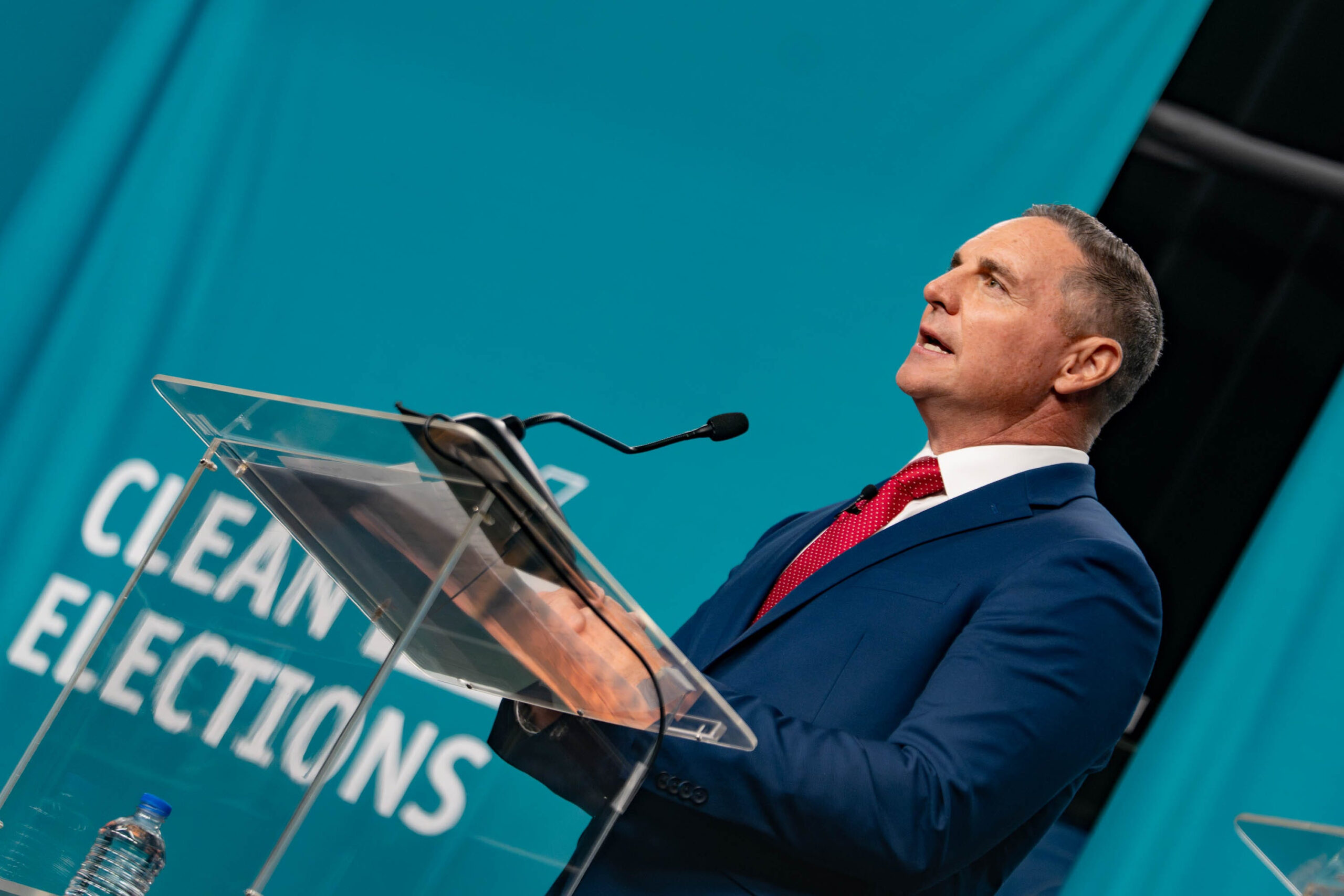
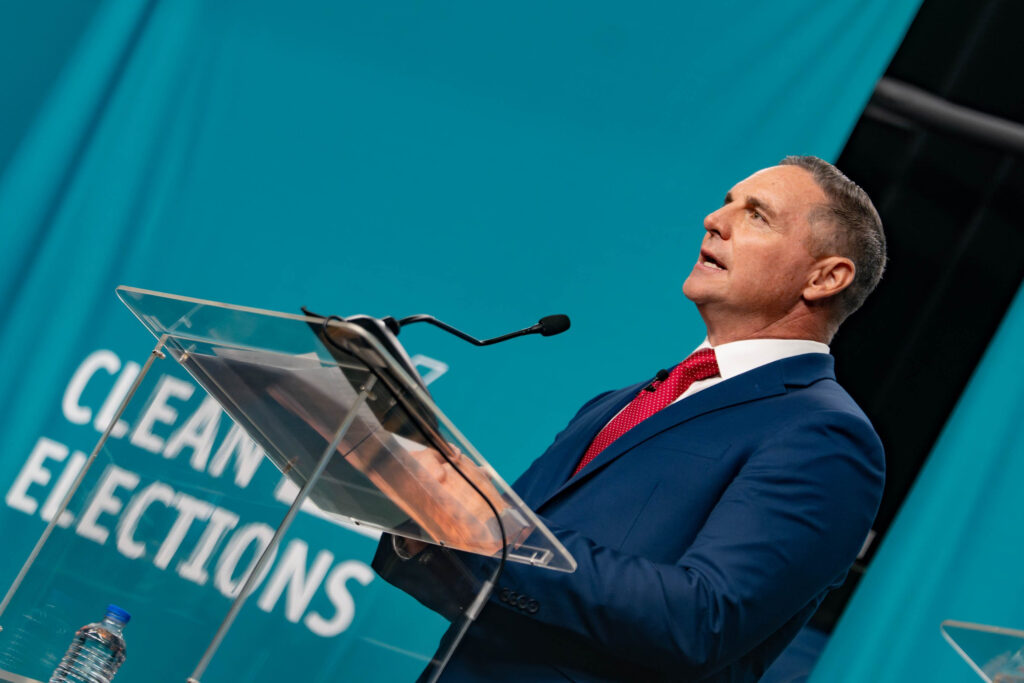
Take Jay Feely, the former National Football League kicker who is backed by Trump in Arizona’s competitive congressional race around Phoenix. Feely has been an outspoken proponent of data centers and the AI industry, despite the state being a hotbed of opposition to the project.
In March, he questioned what data center opponents in another state actually gained from blocking a data center project, saying they are “getting rid of billions of dollars in tax revenue and thousands of jobs” and noting the project will likely just go elsewhere.
“We are one of the fastest areas growing those data storage centers, which are going to be so key to the revolution that’s coming,” Feely said in another interview, acknowledging that these projects need to do a better job communicating with the public. “I want us to be at the forefront of that.”
Feely is getting challenged on the topic in his primary. In a recent debate, Joseph Chaplik, a former Arizona state representative running for the seat, argued the “people in this district do not want data centers right next to their homes” and suggested Feely was too pro-AI.
“We have to understand the fight we’re in here nationally with China,” Feely said about his support for data centers, even suggesting that the opposition to data centers is part of a Chinese influence campaign.
Feely’s support for the AI industry has led them to support him, too. Late last month, Leading the Future, the outside political group backed by prominent investors in OpenAI and other technology leaders, announced it would support Feely in his primary this month. That support, the group says, comes with an initial plan to spend $600,000 supporting the former football player, a figure only slightly less than the $645,000 Feely’s campaign has spent on ad time so far.
Zac Moffatt, co-strategist for the pro-AI outside group, said Feely was a “strong advocate for growing the economy, expanding opportunity for his district’s residents, and securing America’s technological leadership.” He noted Feely’s support for “a national AI framework.”
We asked Feely to detail his position on data centers and AI regulation. Brady Smith, a strategist for Feely, said the Republican was a “strong supporter of making Arizona the epicenter of America’s technological infrastructure, bringing jobs, growth, and investment,” but wants to see that development done in a way that doesn’t raise energy costs, protects water usage and “respects the communities where infrastructure is built.”
The question for Feely and others is whether support for data centers will come with a price to pay from voters.
The polling on data centers — especially those built in communities — has been pretty clear. A Gallup survey in May found “seven in 10 Americans oppose constructing data centers for artificial intelligence in their local area, including nearly half, 48%, who are strongly opposed.” This is an issue that bridges the partisan divide, too. While Democrats are more opposed — 75 percent said they were either somewhat or strongly opposed — a notable 63 percent of Republicans said the same thing.
“Americans everywhere are pushing back against data centers because they are the physical manifestation of their dislike of big tech companies,” said Sacha Haworth, executive director of the Tech Oversight Project. “It doesn’t matter what side of the aisle you’re on, resisting tech CEOs’ influence and holding big tech accountable is actually uniting a lot of Americans.”
Read more How a tiny Argentine town shaped the U.S. men’s World Cup coach
The Supreme Court closed out its term with a bang.
The biggest ruling was arguably the justices’ affirmation that nearly everyone born in the United States is a citizen, a concept known as birthright citizenship. Our colleague Justin Jouvenal, who has been working overtime this week, cast it as a “major decision that rejects a push by President Donald Trump to fundamentally redefine who is American in ways not seen in more than 150 years.”
This was an issue of the utmost importance to Trump, who attended the oral arguments for the case in April, the first time in history a sitting president has attended such a hearing.
The president responded to the ruling by sarcastically congratulating Chinese President Xi Jinping “and the Great Country of China, on their massive Birthright Citizenship WIN!”
The court also upheld bans in Idaho and West Virginia on transgender athletes playing on girls’ and women’s sports teams, our colleagues Julian Mark and Laura Meckler reported, the latest in a string of legal setbacks for the LGBTQ+ community.
“This is a heartbreaking ruling for our clients and transgender girls like them who’ve asked for nothing more than the same opportunities afforded to their peers,” said Joshua Block, senior counsel for the American Civil Liberties Union’s LGBTQ & HIV Rights Project, who argued the case.
And lastly, and possibly the most politically relevant for November’s midterms, the court loosened campaign finance laws by allowing party committees to coordinate with candidates. The decision is a boon for Republicans and threatens to deepen Democratic fundraising woes — something we previewed in this newsletter.
Since we wrote that story in May, the funding disparity between Republican and Democratic committees has only grown. Republicans currently have an almost $150 million cash advantage in committee fundraising relative to Democrats, a divide largely driven by the Democratic National Committee’s continued struggles to raise money.
You can expect this ruling to have direct implications on the midterms, with Republicans already saying they will put that cash advantage to use.
“The RNC has been preparing for this ruling, and we are ready to expand the ways we directly help and provide resources to Republican candidates across the country,” said RNC Chair Joe Gruters.
Verite News (Louisiana): The Louisiana Supreme Court freed a death row prisoner this week, arguing that the evidence that was used against him in his 1998 conviction for killing his former girlfriend’s toddler was “scientifically indefensible.”
Santa Fe New Mexican: The controversy between New Mexico Gov. Michelle Lujan Grisham and the Drug Enforcement Administration is growing. Lujan Grisham has accused the administration of allowing “hundreds of thousands of fentanyl pills to hit the streets of New Mexico as they sought to catch high-level dealers.” “It is the most derelict, despicable act in my long career,” she said.
A few of you sent some truly fun stories about your World Cup experiences.
But first, Dan will share his: My wife and I went to the USA vs. Turkey match in Los Angeles late last month, along with our 4-year-old and my mother-in-law. I’ve been to plenty of soccer matches, but watching my son experience that first U.S. goal off a corner kick on our side of the field will be a core memory for him — and, undoubtedly, for me.
Herb Krasner, who has plans to attend the Australia vs. Egypt match on July 3 in Dallas, wrote in to say he also participated in the famed Oranje fan walk in Houston. If you don’t know what that is, do yourself a favor and watch this.
Krasner wrote he “would generally say that all of the fans coming here from around the world have been just delightful to interact with. A very unifying experience.”
Douglas W. Corkhill wrote about attending the Haiti vs. Morocco game in Atlanta. Haiti had already been eliminated from the contest at that point and “really had nothing to play for,” he wrote. But “you would not have known that from the crowd. It was like a home game for Haiti — easily twice the number of Haitian supporters were in the crowd, and they were LOUD! And when Haiti scored first? OMG!”
Morocco would later tie it up, but then Haiti scored again. “The roof almost blew off the stadium in Atlanta,” he wrote.
“It was clear that Morocco was the better team, and they tied it up again before the half. I don’t know if Haiti even got a shot on goal in the second half as Morocco dominated, eventually pulling away to win 4-2,” he wrote. “After the game the Haitian players came to the end of the field where their fans were seated — no, standing — and saluted them.
Douglas concluded: “So what stands out for me? That a team that had nothing to play for responded to the cheers of their fans, gave it everything they had, and though they came up short went home with their heads held high.”
It’s time to ask you for help. We want this newsletter to be responsive to what our readers want, so tell us: What do you want to know more about? What do you like? What would you like us to cover more? Is there an issue in your community that deserves attention? Let us and your fellow Early Brief readers know at [email protected].
Thanks for reading. You can follow Dan and Matthew on X: @merica and @matthewichoi.
Read more Mariners have big sixth inning to back Woo in an 8-3 victory over the Angels