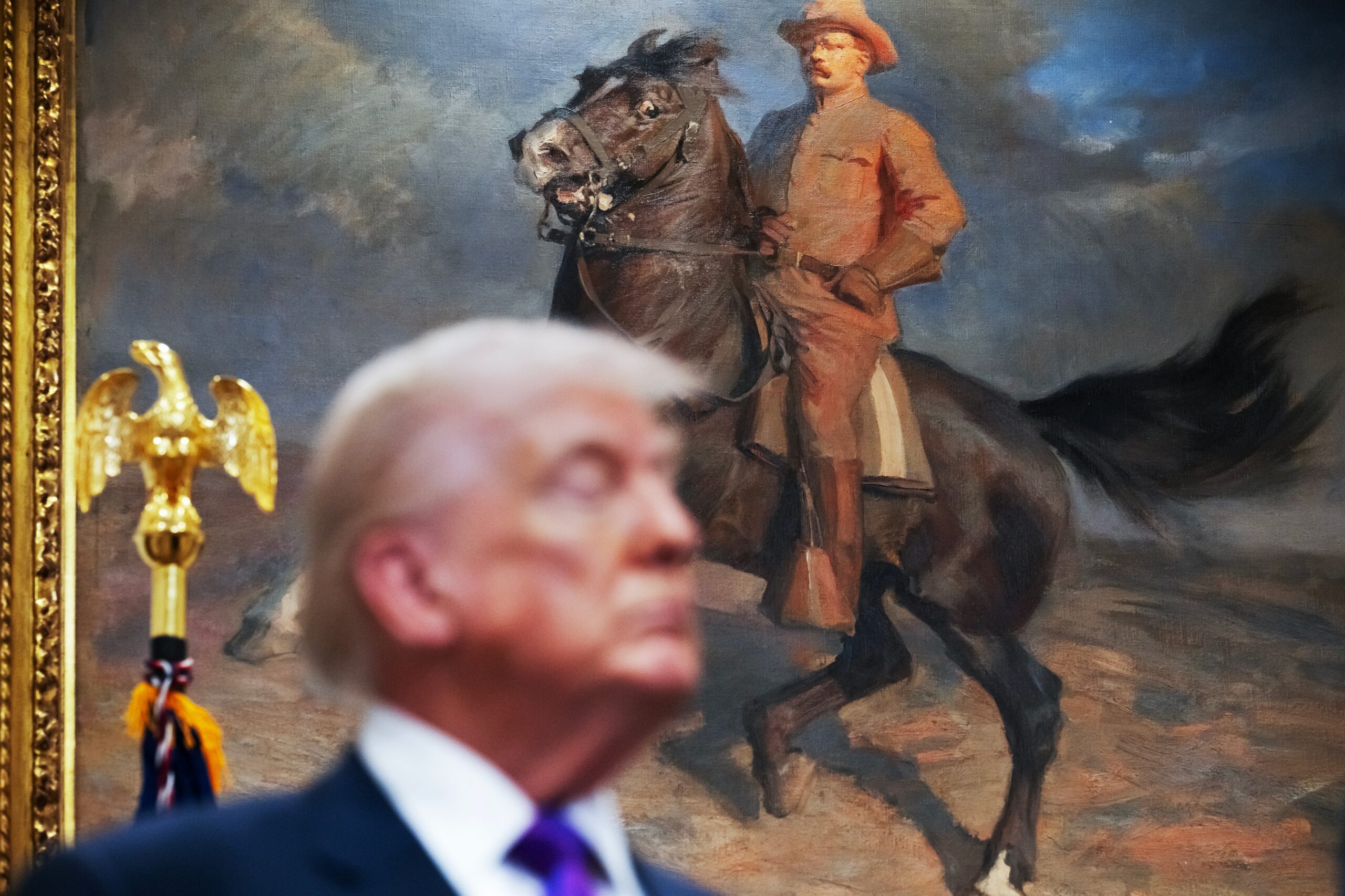
The president plans to fly to rural North Dakota to open Roosevelt’s library as aides tout comparisons between the two.
Read more The unique Republican divide on data centers
BISMARCK, North Dakota — President Donald Trump isn’t exactly the outdoorsman and conservationist that was Theodore Roosevelt, a hunting, wilderness-loving president who preserved hundreds of millions of acres of public land and, in his final years, led a jungle expedition to the Amazon.
Yet the White House wants Americans to know that the two New York natives — one the leader of the Rough Riders volunteer cavalry, the other who spent most of his adult life seated behind desks and in limousines — have plenty in common.
On Wednesday, Trump is scheduled to fly to Bismarck and from there travel to remote Medora, North Dakota, to open Roosevelt’s presidential library, a project that has been in the works for years at the site of the national park bearing the 26th president’s name.
“The parallels between Theodore Roosevelt and President Trump just keep adding up and up and up,” Interior Secretary Doug Burgum, the former governor of North Dakota, said on Fox News Tuesday.
“T.R. was the president at the 125th, President Trump at the 250th — both of them transformative people who really shaped not just the U.S., but shaped the world and the world order,” Burgum said.
The secretary, a longtime Teddy Roosevelt aficionado who as governor helped spearhead planning and fundraising for the library, has made similar comparisons between Trump and Roosevelt for months. In January he said Trump’s Venezuela strikes “can only be compared to Teddy Roosevelt and the Panama Canal 125 years ago.”
Roosevelt saw to the building of the Panama Canal and sent military vessels to Panama City to guarantee Panama’s independence as it seceded from Colombia.
Roosevelt, the youngest man to assume the presidency, and Trump, the oldest, share certain personal qualities, as well. Roosevelt was blustery, egocentric and a rambunctious violator of the existing norms that limited presidential power. Roosevelt’s daughter, Alice Roosevelt Longworth, famously said of her father: “He wants to be the bride at every wedding, the corpse at every funeral and the baby at every christening.”
Both men, too, sought to project overt masculinity from the White House in ways that went beyond typical presidential business. Both, for example, hosted organized fights at the White House.
Unlike Trump at the UFC match he held on his 80th birthday, however, Roosevelt took part in the fighting and was partially blinded as a result.
But while Roosevelt also “threw America’s weight around in the Caribbean,” the differences between him and Trump are larger, said Timothy Naftali, a presidential historian at Columbia University.
“If you look at every other aspect of Roosevelt’s career, the two men would hardly have been simpatico,” Naftali said, contrasting Roosevelt’s establishment of federal regulation of food and drugs against the current administration’s efforts to unwind the Food and Drug Administration.
He also noted that when Roosevelt negotiated peace between Russia and Japan — winning a Nobel Prize in the process — he did so without asking for mineral rights or pieces of territory, a tactic that Trump has repeatedly employed when involved in foreign conflicts.
Read more Voters are angry with Washington, and other takeaways from the Colorado primaries
Trump and White House officials, however, have repeatedly pointed to Roosevelt as a model for some of his policies at home and abroad.
Roosevelt, for instance, intervened in college football after a series of brutal, sometimes fatal, injuries in the early 20th century. National leaders credited him for helping bring rule changes that improved the sport’s safety.
Trump has cited Roosevelt’s actions as he issued several executive orders seeking to reverse changes in college sports that he has described as threats to the games, notably the ability for players to be paid as they repeatedly transfer schools.
“Much like President Roosevelt saved American football,” White House spokeswoman Taylor Rogers said in a statement earlier this year, “President Trump is committed to saving college sports from the threats they face today.”
Trump has long held Roosevelt in high esteem, publicly praising his investments in national parks, his projection of American military power around the globe and his experience leading the “Rough Riders,” a voluntary cavalry regiment during the Spanish-American War.
“Theodore Roosevelt exemplified the unbridled confidence of our national culture and identity. He saw the towering grandeur of America’s mission in the world and he pursued it with overwhelming energy and zeal,” Trump said during remarks at Mount Rushmore on July 3, 2020 — the last time the memorial hosted the president for a fireworks show.
Like Trump, Roosevelt was shot during his third bid for the presidency, which came after exiting the White House. Roosevelt, too, projected defiance, insisting on giving his speech as planned before seeking medical treatment.
The new library that Trump will help dedicate is on the site of the Theodore Roosevelt National Park in the Badlands, where Roosevelt first visited to hunt bison in 1883, and later returned to grieve the death of his wife and daughter and live as a rancher in his 20s.
Roosevelt became concerned about conservation and after becoming president in 1901, went on to establish 230 million acres of public land, according to the National Park Service. He created the United States Forest Service and what are known today as federal wildlife refuges.
After camping in Yosemite National Park, Roosevelt wrote, “It was like lying in a great solemn cathedral, far vaster and more beautiful than any built by the hand of man.” When Congress opposed his attempt to create a national park at the Grand Canyon, Roosevelt used executive power to protect it as a national monument.
By contrast, conservation advocates have slammed Trump’s administration for removing protections from tens of millions of acres of public lands and opening some up for development, timber harvesting and mining.
“The irony of this celebration could not be sharper,” said Aaron Weiss, executive director of the Center for Western for Priorities. “Donald Trump and Doug Burgum are going to cut the ribbon on a library honoring America’s first true conservation president.”
But the Trump administration’s record, “reads like a checklist assault on everything that Teddy Roosevelt has built,” he said.
Read more How a tiny Argentine town shaped the U.S. men’s World Cup coach