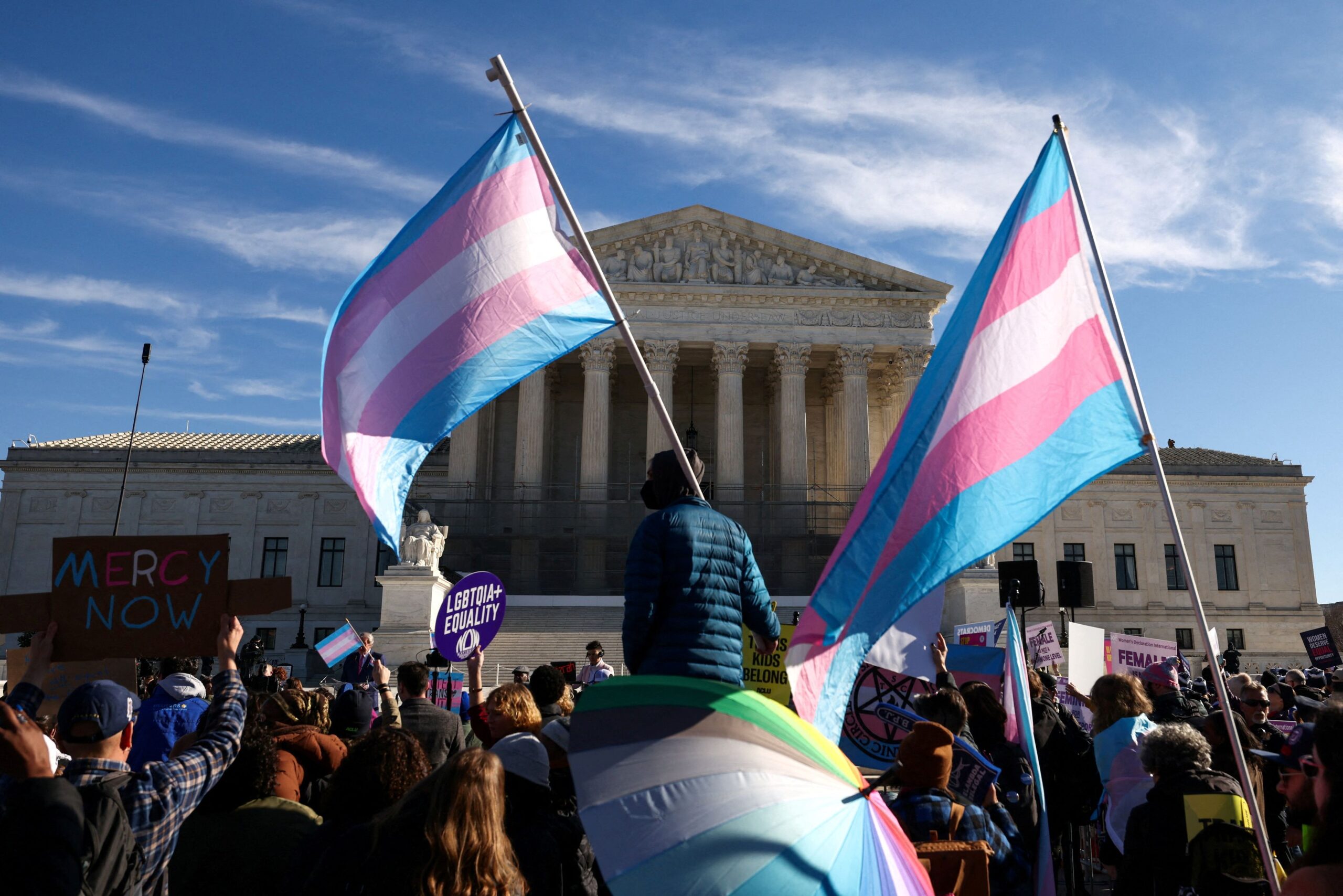
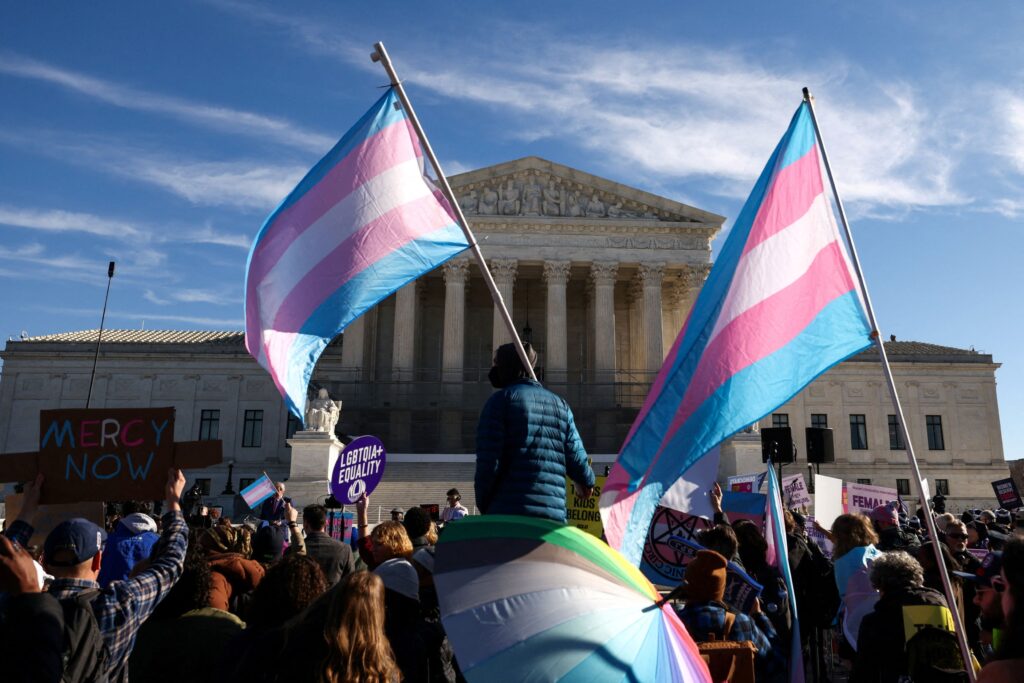
The Supreme Court’s ruling Tuesday upholding state bans on transgender athletes in women’s sports is prompting questions about whether trans rights litigators have made strategic missteps, saddling the ascendant legal movement with sweeping precedents that could hurt their cause for years to come.
Read more Trump to honor a president he sees as a peer — Theodore Roosevelt
Critics, including some trans rights advocates, say the movement has rushed to tee up causes that the court’s 6-3 conservative majority is not ready to embrace — particularly expanded rights for trans athletes, which polls show most Americans oppose. Given the high court’s solidly conservative record on LGBTQ+ issues, some supporters of trans rights are delivering a sobering message: Keep cases away from the Supreme Court.
“The question right now is not whether transgender advocates should fight or not fight — it’s whether going to hostile courts is the most prudent move,” said Duncan Hosie, a fellow at the Stanford Constitutional Law Center and a supporter of legal protections for trans people.
Given the Supreme Court’s opinions last year upholding bans on transition care for minors and this week’s ruling on trans athletes, Hosie said, it’s clear that “courts are not the most prudent move.”
Tuesday’s decision found that states can separate teams based on “biological sex” without offending the Constitution’s guarantee of equal protection and Title IX, a landmark 1972 antidiscrimination law involving education.
The court’s six conservatives led the opinion, but even the court’s liberal justices agreed that such bans do not violate Title IX. They disagreed with the majority’s finding that the bans withstood scrutiny under the equal protection clause.
The ruling capped a year of setbacks for the LGBTQ+ movement, which included a ruling against state bans on “conversion therapy” for gay and trans minors, as well as an order temporarily halting California policies that discouraged notification of parents when their children were socially transitioning at school.
Litigators filing lawsuits on behalf of transgender plaintiffs say they face a frustrating dilemma. On one hand, the Trump administration and Republican-led states have implemented policies sharply restricting the rights of transgender people, and activists say those edicts must be fought.
On the other hand, lawsuits challenging these policies are routinely reaching the Supreme Court and resulting in precedents that are detrimental to trans rights, covering the entire country and potentially lasting for decades.
Chase Strangio, co-director of the American Civil Liberties Union’s LGBT & HIV Project, said he recognizes the movement needs to “adapt.” But there are no easy answers, Strangio said, when “you have every branch of [the federal] government stacked against you.“
“You can’t just throw up your hands and say, ‘No, we are not going to pursue an advocacy strategy on behalf of a community that needs improved conditions of their lives,’” Strangio said.
Jim Campbell, chief legal counsel at Alliance Defending Freedom, a Christian legal group that has opposed trans advocates in a number of cases, said the movement’s problem is not strategy, but that their cases are wrong on the merits.
“The arguments that they’re making in these cases conflict with established law, science and common sense,” Campbell said. “I think that’s why they have hit so many roadblocks.”
Doug Curtis, chief legal advocacy officer at Lambda Legal, which focuses on LGBTQ+ rights, rejected criticism that his organization and others have moved too fast in pushing to expand rights for transgender people before a Supreme Court dominated by conservatives.
“I just think that they’re not right,” Curtis said of those critics. “If we just stepped back and waited until the time was right to bring our case, we would never bring the cases.”
Curtis said the losses only embolden him and others to battle harder in what he sees as a long-game strategy in the face of aggressive anti-LGBTQ+ policymaking.
“It lights a fire of ferocity to fight back, because you can just see through your own personal experience how wrong and hurtful and harmful these laws can be,” he said.
The dilemma is one that has long confronted activists seeking to expand individual rights through the courts. From civil rights in the 1950s to women’s equality in the 1970s, litigators have had to balance an urgent desire for change with the risk that a major ruling would backfire, forcing them pick their cases with care.
Read more The unique Republican divide on data centers
Over the past two terms, the Supreme Court has consistently ruled against expanding LGBTQ+ rights, offsetting or nullifying victories for trans rights advocates in lower courts.
Last year, the Supreme Court allowed the Trump administration to ban transgender people from serving in the military as challenges played out in lower courts. It also sided with the administration in allowing officials, for now at least, to dictate that passports would reflect a person’s sex at birth. The court also found that parents can opt their children out of lessons featuring LGBTQ-themed storybooks, a ruling that has influenced other trans rights cases.
The justices put an exclamation point on this jurisprudence with their ruling on Tuesday, the final day of the court’s 2025-26 term, that allows states to ban transgender athletes in women’s sports.
Among the cases that has attracted the most internal second-guessing is a challenge to Tennessee’s ban on transition care for minors, which resulted in a 6-3 decision last year upholding the ban.
That prompted criticism that trans rights advocates erred in bringing the case to the Supreme Court, especially as some of the scientific evidence about the safety of transition care was being called into question.
The ACLU’s Strangio — the first openly transgender person to appear before the justices — had said during oral argument that Tennessee’s law discriminated on the basis of sex. But Strangio was met with skepticism from the court’s conservatives, who expressed concerns about the evolving nature of the science around transition care and the potential risks to children.
Amid the criticism that the case should not have been brought, advocates stood their ground. Kevin Jennings, chief executive of Lambda Legal, wrote a Washington Post op-ed denying that LGBTQ+ rights litigators had charged too hard against public opinion and erred in thinking they could sway the Supreme Court’s conservatives.
“Some advocates argue that it was too soon to raise this issue with the Supreme Court,” Jennings wrote. “But that suggests there was a choice. With the proliferation of state bans, proposed by opponents of trans equality, this topic was inevitably going to end up at the high court.”
This year, rulings against LGBTQ+ rights kept coming.
“The trans movement has become politically somewhat less popular and has lost some recent cases, so they’re on the defensive,” said Dilan Esper, a California-based civil rights attorney who worked with the ACLU in the 1990s. ”That’s always tough for any civil rights movement to be on the defense, because the tendency is to want to go on offense and do advocacy campaigns and move the ball forward.”
Esper and other civil rights attorneys, including Stanford’s Hosie, said advocates could be more selective with the cases they bring.
“That does not mean that you give up on transgender people right now,” Hosie said. In a forthcoming Cornell Law Review article, Hosie argues for a strategy of “resistance through restraint” when it comes to litigating many liberal causes, including LGBTQ+ issues.
That includes potentially settling cases before they reach the Supreme Court or limiting adverse rulings to a lower court by not appealing them. The goal is to prevent major precedents that could set back the movement for LGBTQ+ rights while organizing outside the court system.
Hosie cited the LGBTQ+ movement’s pivot following the 1986 Supreme Court case Bowers v. Hardwick, which upheld a Georgia law outlawing sodomy in the privacy of one’s home. Instead of continuing to litigate the issue in the federal courts, LGBTQ organizations began lobbying state legislatures to repeal their anti-sodomy laws, while also pursuing claims in state courts. That grassroots strategy allowed the LGBTQ movement to further coalesce and publicize its message on gay rights, Hosie argues.
In 2003, after the Supreme Court’s composition changed, the court overturned the Bowers decision in the landmark case Lawrence v. Texas, which struck down a law banning private “homosexual conduct.”
“In turning to incremental reform over bold legal claims over the preceding years, they allowed the institution and society to change,” Hosie argues in his paper.
Suzanne Goldberg, a professor at Columbia Law School, was co-counsel in the Lawrence case, and she said there should always be a strategic balancing of risk versus reward.
“At the same time, these cases involve real people who are suffering or being actively harmed by laws that seem to be unconstitutional or otherwise invalid,” Goldberg said. “I think sometimes that gets lost in the discussion of strategy and whether the movement is moving too quickly or not quickly enough.”
Read more Voters are angry with Washington, and other takeaways from the Colorado primaries